Sales Methodology Sandler: 7 Steps to Qualify Deals
Use Sandler's seven-step system to expose pain, confirm buying authority, disqualify weak opportunities, and improve pipeline control.
Sandler qualifies the deal before presenting the solution. Its seven-step structure forces both parties to confirm the problem, resources, authority, and next steps, allowing sales teams to advance credible opportunities and disqualify weak ones early.
Pas le temps de lire ?
- Sandler uses a seven-step system that prioritizes mutual qualification before pitching a solution.
- Reps clarify expectations, uncover business pain, establish budget, and map the decision process before presenting.
- The method helps teams disqualify weak opportunities early, but it cannot eliminate buyer delays or inaccurate disclosures.
- Start by adding exit criteria for pain, budget, and decision authority to every qualified CRM opportunity.
What does the Sandler method change about deal qualification?
The sales methodology sandler approach treats qualification as a mutual decision, not an attempt to persuade every prospect. Discovery comes before presentation, and “no fit” is an acceptable outcome for either party.
“Qualification comes before presentation, and disqualification is a valid business outcome.” (October 2026)
This reverses the pitch-first model, where sellers demonstrate value before establishing pain, resources, or authority. The official Sandler methodology overview and HubSpot’s Sandler guide, both accessed October 2026, describe a system built around structured discovery and mutual commitments. The Sandler selling system protects selling capacity by requiring evidence before progression.
What are the seven steps in the Sandler process?
The Sandler seven-step process separates qualification from fulfillment. Each stage needs an operational objective and a verifiable exit criterion.
“Seven stages move the seller from mutual alignment to qualification, fulfillment, and post-sale reinforcement.” (October 2026)
| Stage | Objective | Exit criterion |
|---|---|---|
| Bonding and rapport | Establish trust and equal business footing | Prospect engages openly |
| Up-front contract | Agree on purpose, roles, time, and outcomes | Meeting terms are accepted |
| Pain | Expose a consequential business problem | Impact and urgency are specific |
| Budget | Confirm available resources and investment logic | Funding path is credible |
| Decision | Map stakeholders and approval mechanics | Process, authority, and timing are known |
| Fulfillment | Connect the qualified problem to the solution | Buyer confirms solution alignment |
| Post-sell | Reinforce the decision and prevent reversal | Risks, expectations, and next steps are documented |
The first five stages qualify the opportunity. Fulfillment and post-sell convert that evidence into a controlled buying decision. This mapping follows Sandler’s official framework, accessed October 2026.

How do you set expectations before discovery begins?
An up-front contract removes ambiguity before sensitive questions begin. It defines:
- The meeting’s purpose and desired outcome
- The agenda and available time
- Each participant’s role
- Permission to ask direct questions
- Possible outcomes, including no fit
Use a concise opening:
“Before we start, we have 30 minutes to determine whether this problem is worth solving together. I’ll ask questions about impact, resources, and how decisions get made. Some may be difficult. Is that acceptable? At the end, we can agree on a next step or decide there is no fit. Does that work?”
That agreement makes discovery explicit rather than adversarial.
How do you qualify pain, resources, and decision authority?
Treat pain budget decision as a connected evidence chain. Never accept vague frustration, assumed funding, or a contact’s unsupported claim that they control the purchase.
- Diagnose the operational issue: “Where does the current process break?” and “Who experiences the failure?”
- Quantify the impact: “What does this delay, consume, or put at risk?” Determine how often it occurs and what happens if nothing changes.
- Test resources: “Has funding been allocated?” and “What would justify reallocating budget?” Resources can include money, implementation time, technical capacity, and executive attention.
- Map the decision: “Who can approve, block, influence, or implement this?” Document procurement, legal, security, finance, and executive approval steps.
- Confirm urgency: “What event makes this decision necessary now?”
A deal is not qualified when pain remains generic, the economic effect is unknown, or access to decision stakeholders depends on hope. Record evidence in the buyer’s language, then test it with the buyer.
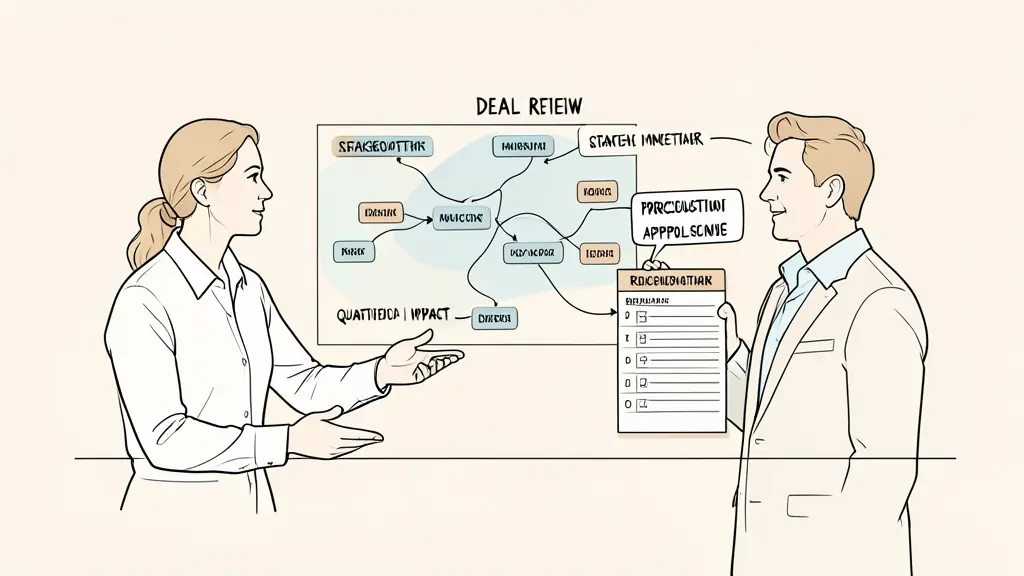
When should you present the solution or disqualify the deal?
In the Sandler selling system, fulfillment starts only when qualification evidence is complete. Use this binary readiness check:
- Specific pain with measurable business consequences: yes or no
- Credible resources and investment path: yes or no
- Identified stakeholders, authority, and approval process: yes or no
- Agreed urgency and next action: yes or no
The Sandler qualification framework supports closing an opportunity when pain is cosmetic, funding is unavailable, authority remains inaccessible, or the buyer repeatedly avoids commitments.
After presentation, restate why the buyer chose to act, surface unresolved concerns, document implementation expectations, and schedule the next interaction. These post-sell controls reduce uncertainty and buyer’s remorse without manufacturing confidence.
How can revenue teams operationalize Sandler in the CRM?
A methodology becomes repeatable only when CRM stages require evidence. Salesforce’s guidance on structured sales processes, accessed October 2026, similarly emphasizes defined stages and consistent activities rather than seller interpretation.
“A CRM stage should describe verified buyer progress, not seller activity.” (October 2026)
Configure each stage with:
- A precise definition tied to buyer evidence
- Required fields for pain, impact, resources, stakeholders, and approval steps
- A dated next action with an owner and buyer commitment
- Exit criteria that must be satisfied before advancement
- Manager questions such as, “What evidence supports this stage?” and “What remains assumed?”
Run the rollout over 30 days:
- Baseline stalled deals and identify missing qualification evidence.
- Train the team on one qualification stage per week.
- Review recorded calls against the relevant exit criteria.
- Audit CRM fields for evidence quality, not simple completion.
- Revise ambiguous criteria when managers interpret them differently.
Do not automate stage progression from email activity, meeting counts, or proposal delivery. Those signals measure seller motion. Predictable revenue requires verified buyer movement.
FAQ
Is Sandler suitable for B2B SaaS sales?
Yes. Its emphasis on discovery, qualification, and mutual commitments fits complex SaaS deals with multiple stakeholders and longer buying cycles.
How is Sandler different from traditional solution selling?
Sandler delays the presentation until the rep has validated the problem, commercial impact, available resources, and buying process. It also treats disqualification as a productive outcome.
Does Sandler require sales representatives to follow a script?
No. It provides a structured sequence and questioning principles rather than a rigid script. Teams should standardize stage outcomes while allowing natural conversations.
Can Sandler be implemented in a CRM?
Yes. Translate its qualification stages into required fields, exit criteria, next-step dates, and manager inspection points without turning discovery into a checkbox exercise.
Envie d'aller plus loin ?
Laisse ton email, on te prévient dès qu'un nouvel article sort.